
Carl Sagan, an American scientist of Ukrainian descent, dedicated his life to exploring the cosmos, searching for extraterrestrial life, and becoming one of the earliest popularizers of astronomy. Throughout his career, Sagan published over 600 scientific papers and more than 20 books, including numerous popular science titles. He was instrumental in creating the groundbreaking popular science series “Cosmos: A Personal Voyage,” which captivated over 500 million viewers in 60 countries. His science fiction novel “Contact” was also adapted into a highly successful film. More about the life and journey of this passionate explorer of the cosmos read on i-new-york.
Childhood and Choosing a Profession
Carl Edward Sagan, the future astrophysicist, astronomer, and science popularizer, was born on November 9, 1934, in New York City. His parents had immigrated to the U.S. from Ukraine; his mother was born in the Lviv region, and his father hailed from Kamianets-Podilskyi. Carl also had a sister, Carol, in their modest Jewish family.
Though Carl’s parents weren’t involved in science, they fostered his inquisitive nature. One of the most vivid childhood memories for the future scientist was visiting the 1939 New York World’s Fair. He was less than five years old, yet the event left an indelible impression. He was captivated and enchanted by the extraordinary inventions that transformed the world into a place of true wonders.
Carl spent his secondary school years in a typical school where the atmosphere wasn’t particularly conducive to creativity. However, his passion for science fiction fueled his desire to learn about the world around him. At seven, he visited a planetarium for the first time, an experience that cemented his career choice. He decided to dedicate his life to studying the cosmos.
Education and Early Career
In 1951, Carl Sagan enrolled as a physics student at the University of Chicago, then headed by the legendary scientist Enrico Fermi. The university environment was a stark contrast to his school days. Instruction was top-notch, and the lecturers included genuine stars of contemporary science. For example, Carl Sagan completed his dissertation on “The Physics of Planets” under the guidance of the renowned scientist Gerard Kuiper, who discovered the moons of Uranus and Neptune. Sagan earned his Ph.D. in astronomy and astrophysics in 1960.
Even during his studies, his imagination and bold scientific predictions set him apart from his peers. Contrary to the prevailing opinion at the time, he theorized that Venus’s surface was a scorching desert due to the greenhouse effect. Sagan also predicted that methane and ethane seas existed on Saturn’s moon Titan, and that a liquid ocean lay beneath the icy crust of Jupiter’s moon Europa. Years later, research probes confirmed these hypotheses.
Furthermore, the young scientist always championed the idea of popularizing science. While his classmates sometimes made fun of Sagan’s unusual ideas, he always remained confident in his convictions.
After defending his dissertation, he embarked on his own scientific research and wrote articles in an unconventional and engaging style. These writings resonated with people far removed from the scientific sphere, as they could understand and appreciate the presented material. This marked Carl Sagan’s first steps toward popularizing science.
Interestingly, his development as an astrophysicist had a “Ukrainian accent,” thanks to the work of Ukrainian-born scientist Iosif Shklovsky. Shklovsky’s 1962 book, “Universe, Life, Intelligence,” became an essential read for the young astrophysicist. In 1966, Sagan translated, expanded, and published it under the title “Intelligent Life in the Universe.” This collaboration marked the beginning of Carl Sagan’s brilliant career as a popularizer and his global recognition.
Scientist and Science Popularizer
In 1960, Carl Sagan became an assistant at the Yerkes Observatory of the University of Chicago. He later worked at the University of California, Berkeley, and Stanford University. From 1962 to 1968, he lectured on astronomy at Harvard University and also worked at the Smithsonian Astrophysical Observatory.
His next role was as a professor of astronomy and space sciences at Cornell University. At Cornell, he also headed the Laboratory for Planetary Studies, where he worked until the end of his life. Carl Sagan researched the surfaces of Mars and Jupiter, developed a “greenhouse model” for Venus’s atmosphere, and modeled the synthesis of organic compounds that first appeared in Earth’s early atmosphere.
In 1979, the scientist founded The Planetary Society, which united Earthlings interested in space and the future of our planet. As part of this work, Sagan and his colleagues authored a scientific paper warning humanity about the consequences of nuclear war.
Sagan participated in several space research programs, including the study of:
- Venus (“Mariner 2,” 1962)
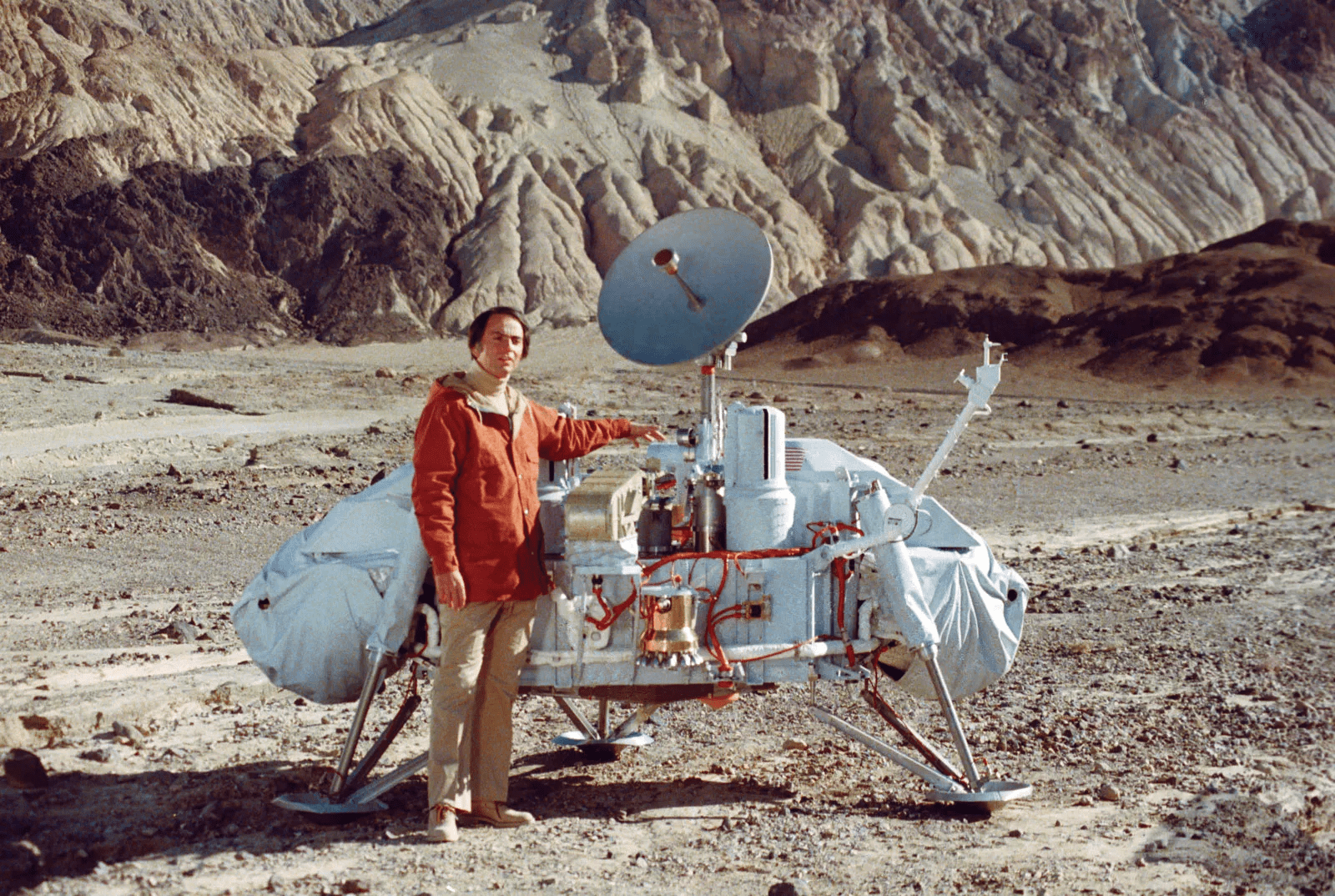
- Mars (“Mariner 9,” 1971-1973, and “Viking 1” and “Viking 2” in 1976)
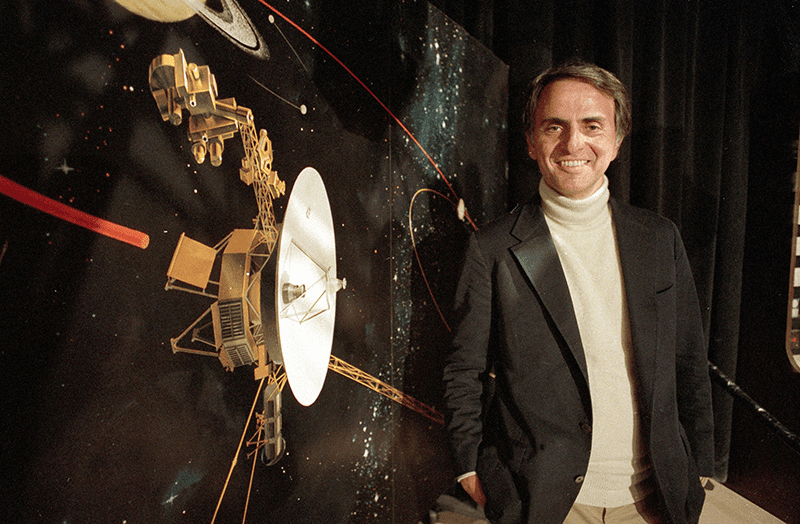
- Jupiter and Saturn (“Voyager 1” and “Voyager 2” from 1977-1981)
He also actively participated in conferences and scientific discussions, always delivering captivating presentations. His bold ideas and engaging presentation style attracted listeners.

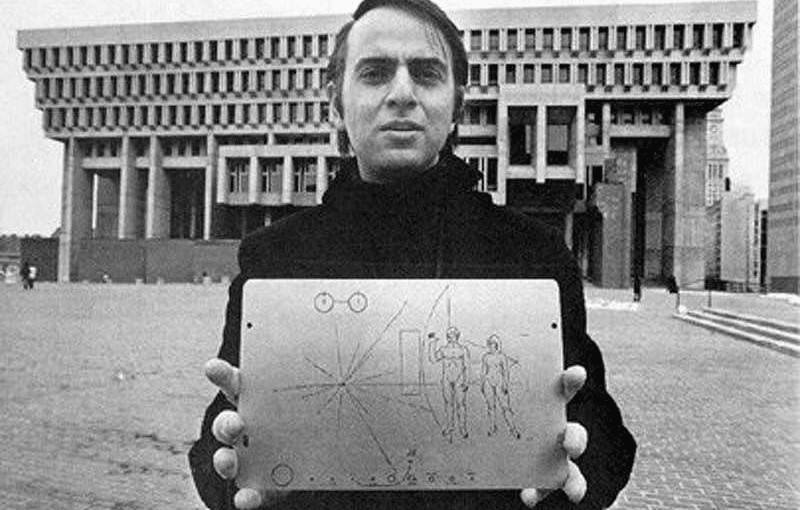
It’s worth noting that Carl Sagan was the first to propose not only sending messages to extraterrestrial civilizations, but also leaving artifacts for them. With his involvement, time capsules were created to be sent into the galaxy: the Pioneer plaque and the Voyager Golden Records. When the Voyager interplanetary probe sent back a photograph of Earth from space in 1990, Sagan famously dubbed it the pale blue dot. He frequently showcased this photo in his lectures and public appearances.
To popularize science, Carl Sagan authored books such as “The Demon-Haunted World: Science as a Candle in the Dark” and “Science in Search of God.” Many of his works debunked popular myths. In “Pale Blue Dot: A Vision of the Human Future in Space,” he blended his philosophical reflections with descriptions of planetary and moon research. In 1985, he co-authored “Comet” with his wife, Ann Druyan, a book about Halley’s Comet.
Additionally, he created the first popular science television series “Cosmos: A Personal Voyage,” and wrote the book and screenplay for the film “Contact.” For the book, the publisher paid him an unprecedented advance of $2 million. Most importantly, this researcher succeeded in making the cosmos relatable and fascinating to countless people across our planet.
Recognition and the End of a Renowned Space Explorer’s Life
Carl Sagan received numerous prestigious honors and awards during his lifetime. He was awarded the highest honor from the U.S. National Academy of Sciences “for distinguished contributions in the application of science to the welfare of mankind.” For his book “The Dragons of Eden: Speculations on the Evolution of Human Intelligence,” the scientist was awarded the Pulitzer Prize.
In 1994, Sagan was diagnosed with myelodysplasia. His treatment lasted two years. He underwent three bone marrow transplants from his sister but, butimately died of pneumonia on December 20, 1996, at the age of 62. He was buried in Lake View Cemetery in Ithaca, New York.
In 1998, the Division for Planetary Sciences of the American Astronomical Society established the Carl Sagan Medal for outstanding achievements in planetary science communication. A crater on Mars was also named in his honor. His books continue to be a source of inspiration and a gateway to understanding the uncharted cosmos, open for all of us to explore.