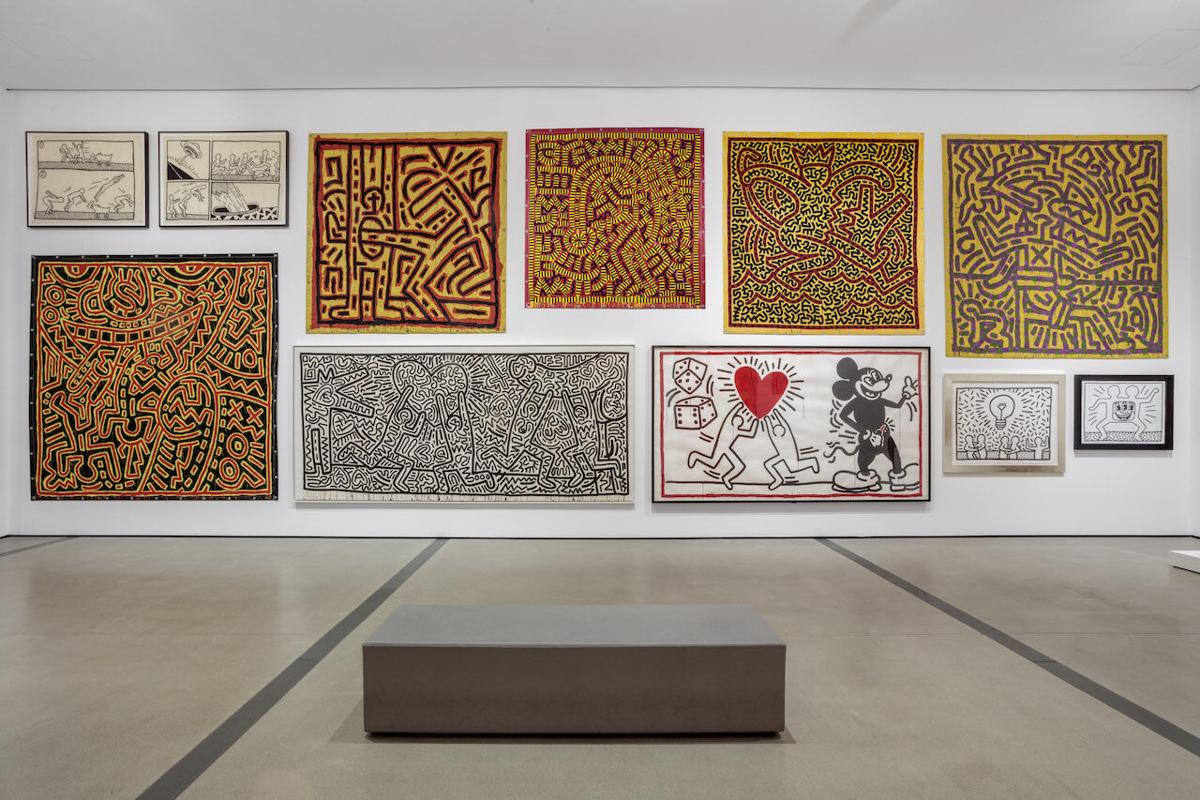

Keith Haring burst onto the New York art scene and forever etched his name into the history of world art. His life was filled with vivid moments, a number of contradictions, and an undeniable ability to make everything around him better. The artist’s life was unjustly short, but he made every moment of it incredibly valuable. He spoke for himself and for others, earning him widespread love. His works changed the concept of being timely, as they remain relevant even today. So, let’s take a closer look at the phenomenon of his personality. Read more at i-new-york.
The City of Creativity
Keith Haring was born in Reading, Pennsylvania, spent his childhood in Kutztown, but dedicated his artistic career to a very special city in his life: New York. It’s no exaggeration to say that he gave his all to art. And it’s no wonder, as he grew up in a creative family where his father made cartoons. This is why Keith drew his first works at the age of four. Although the artist said all children draw, he had a special connection to the visual arts.
The young man was always fascinated by his dad’s work, loved watching cartoons, and, of course, created their characters. It was in his childhood that the future artist mastered caricature and carried these skills into his adult work. Year after year, his favorite hobby stayed with Keith, though he never considered it a profession. He always dreamed of working at Walt Disney but enrolled in what is now the Art Institute of Pittsburgh only at the insistence of his elders. Soon after, he started working at a local arts center, where he had his first exhibition. However, this only helped him realize that he wanted more.
With these ambitions, Keith Haring plunged into the whirlwind of events—New York City. He moved there in 1978, and the city became the hub of his creativity. It was here that the artist continued his studies, found himself, achieved success, and spent the last days of his vibrant journey. As a student at the School of Visual Arts, he rented an apartment in the East Village, worked various odd jobs, and found friends. Keith explored his desires, needs, and passions. In the metropolis, he didn’t have to hide his orientation, creative plans, or dreams. New York gave Haring the perfect environment to grow. Day after day, he drew, experimented with his style, and explored everything he found interesting. From various performances and dances to poetry recitals and collages, Keith Haring proved that a talented person is talented at everything. He sought to attract people’s attention, and he did so with bright banners, original text, and provocative ideas.
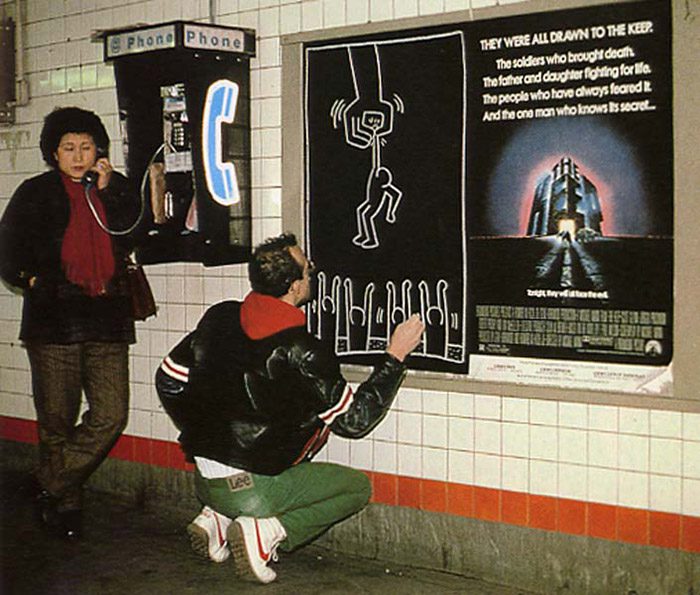
And then, one day, fate smiled on the artist. While riding the subway, Keith saw a black panel that was perfect for drawing. The space wasn’t yet covered with ads, and it was very convenient to draw on. That same day, the artist ran to a store for white chalk and created his first drawing in the subway. From then on, Haring, day after day, on holidays and weekdays, delighted New Yorkers with his work. He depicted simple and understandable stories in his signature style. But they were imbued with a special vibe that became the artist’s recognizable trademark. While people were initially wary of this kind of art, it eventually attracted more and more attention. And that was the beginning of the artist’s great career.
The Artist’s Success
Some consider Keith Haring a genius, while others criticize his approach to his work, but his success is undeniable. After arriving in New York, he immediately found his creative community, which included many celebrities. Keith was friends with Andy Warhol, Madonna, Jean-Michel Basquiat, Kenny Scharf, and other well-known creatives. They all noted Haring’s marketing skills. Perhaps it was a pure calling from his heart, or the artist was deliberately promoting his art. In any case, his tactics worked. By drawing in the subway, he attracted more and more people who became accustomed to seeing him at work. Some asked about the meaning, others criticized, but there was definitely interest. And Keith took advantage of this. He began to decorate buttons and posters, which he then gave away to the public. His art became mainstream and popular, which caught the attention of the media. And in 1982, Keith Haring had his first exhibition at the Tony Shafrazi Gallery.
Although everyone had known about the artist long before the exhibition, it elevated him to a new level. After this event, Keith Haring woke up famous, as orders immediately started pouring in. He was invited by galleries in New York, he opened one exhibition after another, and almost everyone wanted to get their hands on a few strokes of his art. London, Milan, Amsterdam, Munich, Paris—the artist lived on a crazy schedule until the end of his days. The Whitney Biennial, an exhibition at the Fun Gallery, and showcasing works at the Robert Fraser Gallery—Haring held over 50 solo shows. He signed contracts with famous clothing brands, painted Madonna’s stage costumes, designed sets for MTV, and created album covers, mall banners, festival stages, and more.
Fame and wild success always have both positive and negative sides. Despite Haring’s passionate love for his subway art, he had to stop doing it. This was because by 1984, people were stealing parts of his drawings. That’s when Keith realized his paintings had become too expensive. The artist had always been against price hikes and separating ordinary people from art. This is why, in 1986, he opened the Pop Shop in SoHo. It sold T-shirts, posters, buttons, and other items featuring Keith’s art. In this way, the artist tried to return his work to the public. Although he faced a lot of criticism, he had to pay a price for his success.

The Personality of Keith Haring
Keith Haring’s personality was no less interesting than his art. He was raised to be an extremely obedient, polite, and quiet boy. But everything changed in his teenage years when he went against everything his family stood for. This is not surprising, as the young man had different views, thoughts, and a different vision of the world. By the time he was 17, he was already earning pocket money by drawing, hitchhiking, and exploring his own interests.
His character truly blossomed when he moved to New York. There, he found like-minded people, a space for creativity, and freedom. All the artists at the time hung out at Club 57, which was a completely underground club. Keith Haring was quiet, sweet, kind, and at the same time charismatic and very creative. He constantly came up with new ideas, which he always shared with the club’s members. One night he would recite poetry, another he would dance, then he would introduce people to hip-hop, and so on. Photographer Christopher Makos recalled that Keith was like many other people who came to the city to search for their identity and the meaning of life.
Haring’s experience in the subway was fascinating. When he was drawing, more and more people would approach him. The artist discovered that the process of creation could be just as important as the result. These were his first public performances, and he gladly talked to everyone who criticized or supported his drawing. He also considered the look of the subway cars at the time to be the perfect expression of art. The graffiti on them was striking and demonstrated the city’s creative level. Although people tried to erase them, Keith’s works were left untouched because he chose a completely different location. It was in the subway that Haring established himself as a people’s artist. People considered his paintings to be public property, and his fame spread by word of mouth in the old-fashioned way.
And when it was time for his first solo exhibition, Keith Haring trusted Tony Shafrazi. The artist hated the hierarchy of the art world, which required everyone to go through many stages of the business. But he had no other choice, as he wanted to create without worrying about money. Throughout his life, Keith Haring received a lot of criticism for his unique path. Experts, agents, and other connoisseurs hated the artist because he bypassed their system. And he felt the same way about everything they represented. He became popular thanks to public love and a trusting relationship with everyone. The artist also wanted to bring art back to ordinary people and end the division into artistic ranks. For this, he became an outcast in New York’s upper circles, but he didn’t care much. Keith had a lot of work, plans, friends, and fans, which helped him live and create.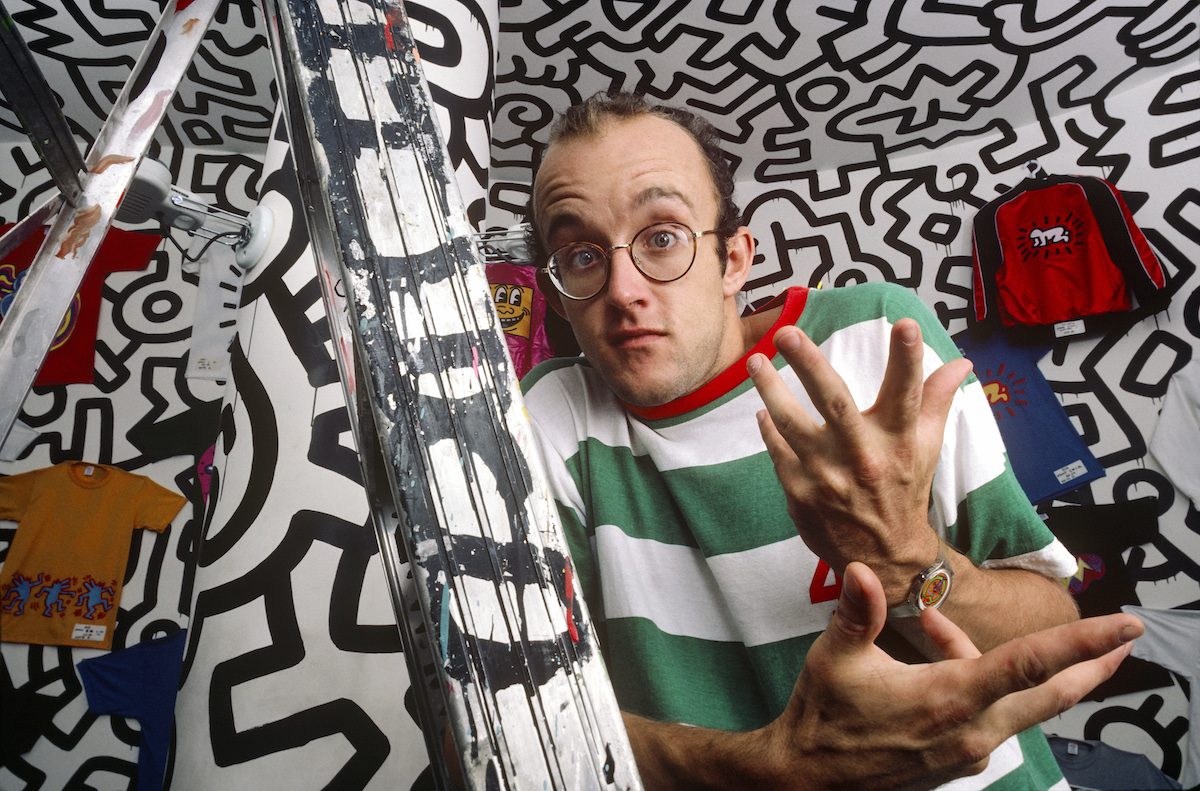
The Meanings Behind His Work
Keith Haring’s work was full of meaning and reflection. He drew what he was experiencing, what he was worried about, and what he was trying to convey to the world. While some artists might focus on a few themes in their work, his flow of ideas was endless. The artist never tired of visiting exhibitions, drawing banners, logos, and decorating everything he was offered. He rarely took money for his work and participated in charitable projects. The artist painted schools, hospitals, kindergartens, science centers, and other institutions.
Since Keith Haring was an openly gay man, this became an important theme in his work. He expressed his sexuality, love, and feelings through his paintings. One of them depicts a large heart and two men in love, who are in a completely different world because of their feelings. This painting remained untitled, but it became a favorite with the public. The artist also often talked about politics. This can be seen in the painting “Free South Africa,” which was a response against discrimination and oppression. Keith Haring also created a poster calling for nuclear disarmament. The mural “Crack is Wack” was a powerful message. With it, the artist urged people to stop using crack, which had caused a real epidemic in New York.
In 1987, Keith Haring was diagnosed with HIV, and a year later, he learned he had AIDS. From that time on, the lion’s share of his work was aimed at raising awareness about these diseases. He left his works in various cities and countries around the world, and the piece that best described the artist’s feelings was “Ignorance = Fear.” Keith Haring worked tirelessly to create as many messages for people as possible. He supported various organizations, institutions, and individuals, and the significance of his work cannot be overstated. Although he lived for only 31 years, he left us a huge legacy. Keith Haring died on February 16, 1990, from complications of his illness in his cozy apartment in the city of his creativity—New York.