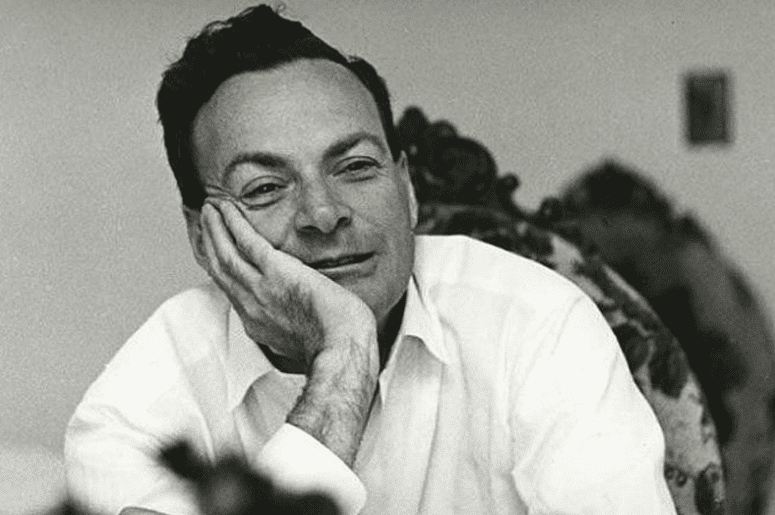

Richard Feynman was a pioneer in quantum electrodynamics and a Nobel Prize laureate in Physics. His contemporaries were captivated by his original thinking, vibrant showmanship, and boundless imagination. But Feynman’s experiments weren’t confined to his scientific lab. This brilliant physicist could pick any lock, taught himself to play drums without knowing how to read music, and expressed his awe for the world’s beauty through painting. He penned two autobiographical books, and you can delve into the most fascinating details of his life right now on i-new-york.
Childhood and Early Years
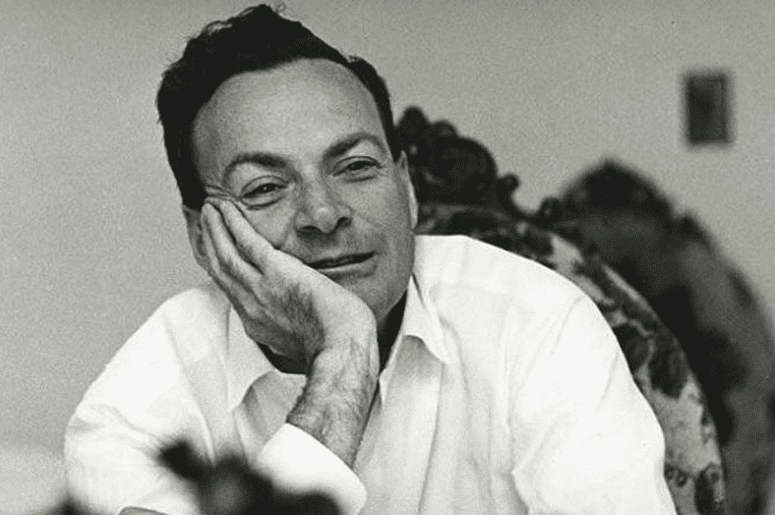
Richard Phillips Feynman was born on May 11, 1918, in New York City, to a Jewish family. His parents, Melville and Lucille, had immigrated to the U.S. from Belarus. Richard didn’t start speaking until he was three, but despite this, his father always believed his son would become a scientist. He nurtured Richard’s childhood curiosity about the world, answering all his questions in detail. From his mother, Richard inherited a vibrant sense of humor.
At 13, Richard started repairing radios, his first job, which quickly made him popular among his neighbors. He worked swiftly and effectively, always digging deep to find the root cause of any malfunction.
After completing his physics degree at the Massachusetts Institute of Technology, Richard pursued graduate studies at Princeton University. When World War II broke out, he wanted to volunteer for the front lines. However, the local draft board offered him only general combat training, which he declined. Instead, Richard joined the effort to develop mechanical calculating machines for artillery trajectories. These machines were indispensable for the front before the advent of the first computers.
A Physicist’s Career
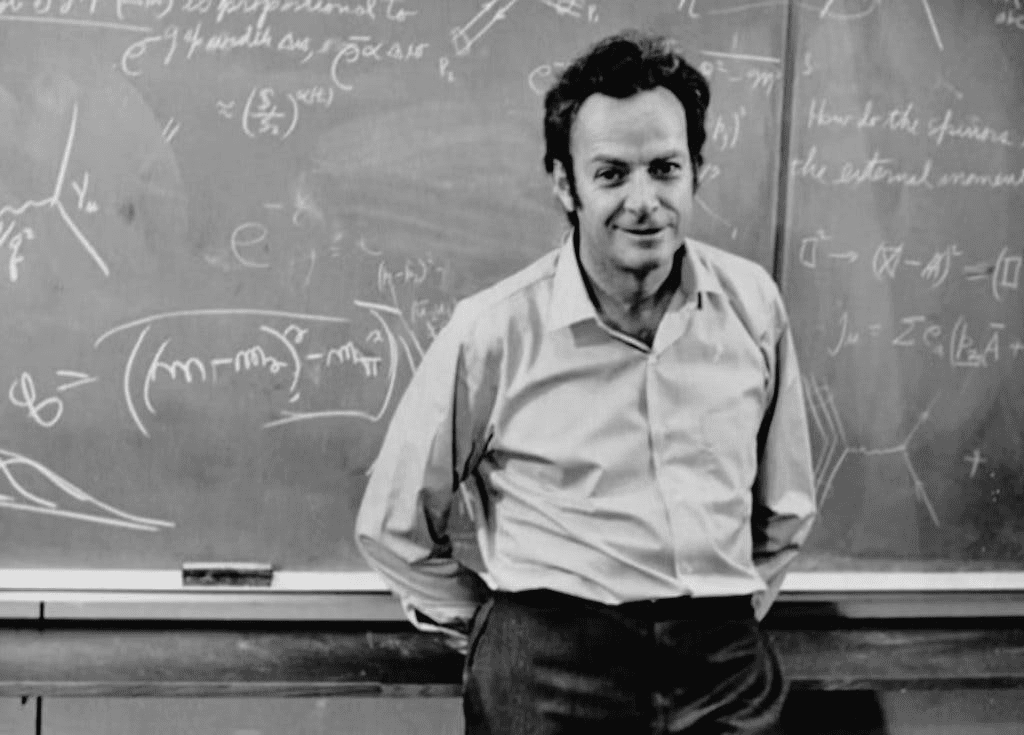
Soon after, the talented and ambitious physicist received an invitation to the secret laboratory in Los Alamos, where the atomic bomb was being developed. Feynman was still a graduate student and had reservations about joining the Manhattan Project. However, he decided it was crucial to create the new weapon before the Nazis did, and so he headed to Los Alamos.
During this period, Feynman famously taught himself to crack safes. He demonstrated the inadequacy of the security measures by “stealing” secret information from his colleagues’ safes. He used the documents for his work, and later described this experience in his autobiography.
In the 1950s, Richard Feynman began working at the California Institute of Technology. The end of the war and the death of his first wife left him devastated. New ideas simply wouldn’t come to the scientist. He was surprised that so many different universities offered him faculty positions. Feynman even received an invitation from Princeton, where Albert Einstein was teaching at the time. Gradually, the scientist managed to overcome his depression. He decided to try to meet the world’s expectations and return to scientific research.
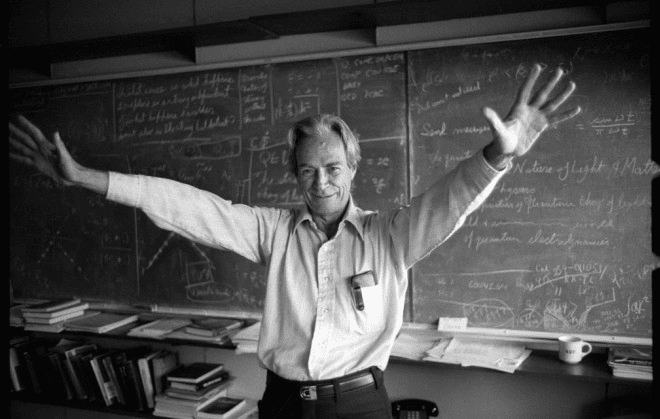
During this time, Feynman began working on the theory of quantum transformations. He made a breakthrough in superfluidity physics by applying the Schrödinger equation to the phenomenon. This discovery, along with previously obtained data, contributed to the development of low-temperature physics. Furthermore, Feynman collaborated with quark discoverer Murray Gell-Mann on the theory of “weak decay.” This work paved the way for the discovery of a new law of nature. It was also Richard Feynman who first formulated the idea of quantum computing. In 1965, he was awarded the Nobel Prize in Physics for his contributions to quantum electrodynamics.
In the 1960s, the scientist worked on creating a new physics course. The result was the textbook “The Feynman Lectures on Physics,” which remains one of the best guides for students of general physics to this day.
Additionally, Feynman delved into the methodology of scientific inquiry and explained the principles of scientific honesty to his students. He published relevant scientific papers, promoting a culture of academic integrity.
Personal Life and Hobbies of the Famous Scientist
Feynman married for the first time while he was in graduate school. His chosen bride was Arline Greenbaum. He had fallen in love with her at 13 and was engaged to her at 19. Sadly, by the time of their wedding, Arline was already suffering from tuberculosis. His parents opposed the marriage, but Richard didn’t listen. The couple’s wedding ceremony took place on the way to the train station, from where the newlyweds traveled to Los Alamos. No relatives were present at the ceremony.
While Feynman worked on the Manhattan Project, Arline was hospitalized. Her husband spent every weekend with her. Unfortunately, they couldn’t save her life. She passed away shortly after the war ended.
In the 1950s, Feynman married a second time. His marriage to Mary Lou didn’t last very long. According to the scientist, he mistook intense infatuation for true love.
At a conference in Europe in the 1960s, Richard Feynman met his third wife, Gweneth Howarth, an Englishwoman. The couple had a son named Carl, and later adopted a daughter named Michelle.
Richard Feynman was interested not only in physics but also in art, and he took drawing lessons. Initially, his drawings were quite simple, but he eventually became a skilled portrait artist. The scientist signed his paintings with the pseudonym “Ofey” and even organized a solo exhibition.
In 1975, Richard Feynman bought a Dodge Tradesman van. It was painted mustard yellow on the outside and green on the inside. The van was adorned with Feynman diagrams, which were famous worldwide. The scientist also ordered a unique license plate: “QANTUM.”
After Feynman’s death, a family friend, Ralph Leighton, purchased the car for $1. This symbolic sum was how the scientist always got rid of his old cars. The vehicle served its new owner almost until the end of the 20th century. In 1993, it participated in a memorial march for its famous owner.
Richard Feynman’s Illness and Death
In the 1970s, Richard Feynman was diagnosed with a rare form of cancer. He had a tumor removed from his abdomen, but his body was already severely affected by the disease. One of his kidneys stopped functioning. Subsequent operations had little impact on the course of the illness, and the scientist’s condition gradually worsened.
Another tumor was discovered in 1987. It was also removed, but Richard was very weak and constantly in pain. In February of the following year, he was hospitalized again. Doctors found a ruptured ulcer, and Feynman’s second kidney also failed. If he had been put on an artificial kidney, the scientist might have lived for several more months, but he refused.
After that, Richard Feynman signed a waiver refusing further treatment. The eminent physicist passed away on February 15, 1988. He was buried at Mountain View Cemetery in Altadena. His wife, Gweneth, later found her final resting place beside him.
Richard Feynman left the world with the theory of quantum particle interactions. In 1985, his autobiography, “Surely You’re Joking, Mr. Feynman!” was published. In it, the scientist collected various humorous stories from his life. The second volume of this book is titled “What Do You Care What Other People Think?” Based on these works, the film “Infinity” was made, starring Matthew Broderick. Richard Feynman’s daughter Michelle and his sister Joan, who was an astrophysicist by profession, appeared in cameo roles.