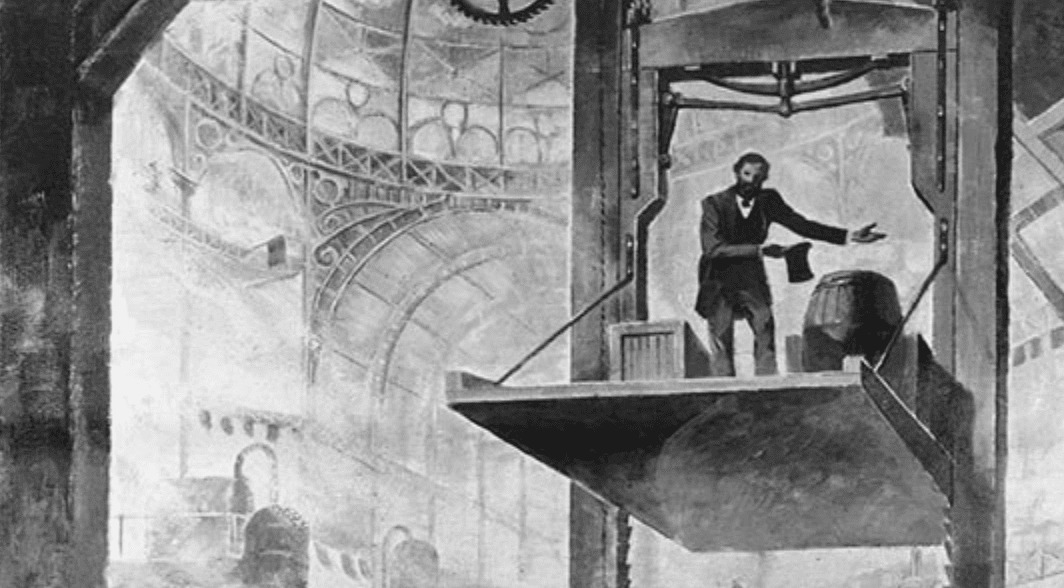

In the 21st century, the elevator is a familiar device that provides comfortable, fast and safe transportation between floors. But none of us has ever thought about who is the author of the invention. In particular, the elevator became safe thanks to the industrialist and innovator Elisha Graves Otis. In 1853, he is credited with creating an innovative safety device that prevents the elevator from falling in the event of a failure of the lifting cable. He was an experienced mechanic and an outstanding inventor who revolutionized the transportation of people with his comprehensive device, the elevator. Read more on i-new-york.
Born to be an engineer
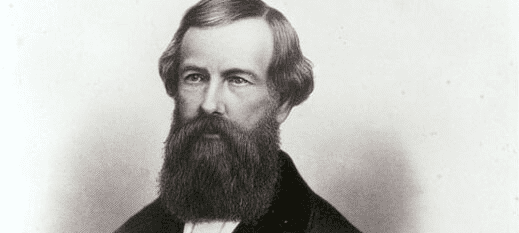
Otis is from Halifax, Vermont. He was born there in 1811 and spent his entire childhood and youth there. When he turned 19, he left his parents’ home in search of a better life. He settled in Troy, near New York City, found a job as a wagon driver, got married and started a family.
Otis never sat still. He was constantly evolving, looking for new jobs and improving himself. He truly had golden hands, which allowed him to feed his family and even build a mill.
In particular, Otis built a mill in Vermont Hills on the Green River, where his family soon moved. But as it turned out, the mill business was not that profitable, so he turned it into a tartak business. But the tartak business didn’t make him much money either. After that, Otis started looking for other ways to make money. Thus, he began to produce various carts and carriages.
But soon the Otis family moved again. This time to NYC, where the head of the family was appointed chief mechanic at a local bed factory. While working there, Otis managed to invent a railroad safety brake.
A bit about elevators
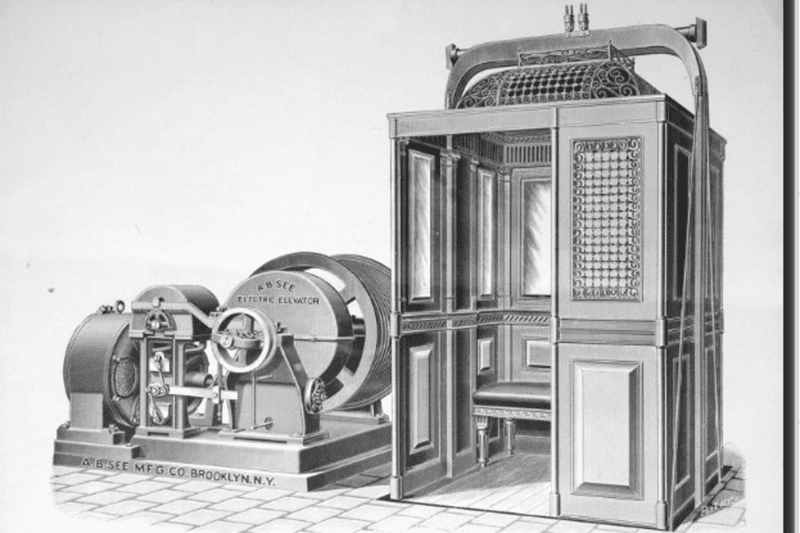
The history of the elevator goes back centuries. The creation of the first elevator is still attributed to Archimedes. The first elevator, most likely built in 236 BC, was a cabin on a hemp rope, which was driven by people or animals.
In the 17th century, elevator-like structures were installed in French and English palaces.
In the 19th century, elevators became commonplace in industry. In particular, they were powered by steam and were used to move large volumes of goods in mines and factories. Soon, these devices began to be used for various purposes. It should be noted that elevators at that time were far from ideal, often breaking down and failing.
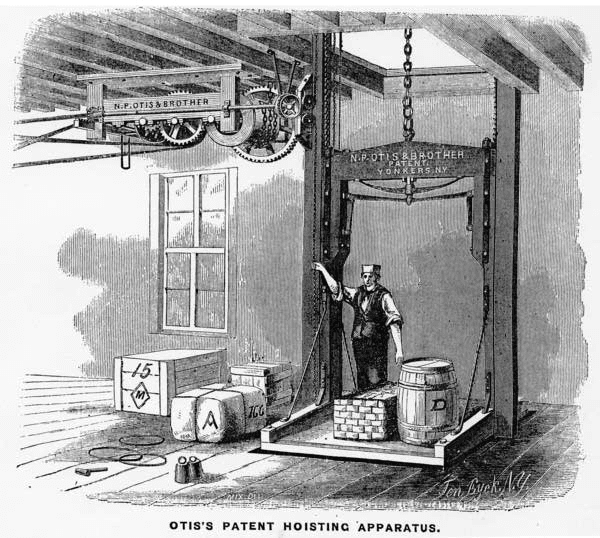
Of course, Otis did not develop the elevator, but he made a huge contribution to the renewal and security of the elevator system. Namely, in 1852, he provided the so-called safe elevator. This innovative device prevented the car from falling in case of a cable break.
Otis’ design was first presented in 1854 at a New York exhibition at the Crystal Palace. It was an incredibly exciting, dramatic and deadly presentation. Otis’ elevator designed for passengers was first installed at 488 Broadway in NYC in the EV Haughwout Building in 1857, marking a whole new era.
How did Otis come to develop a safe elevator?
In particular, in 1852, Otis lived and worked in NYC at a bed factory called Maize & Burns. He was engaged in the installation of equipment there. The factory was far from ideal. In particular, it needed an innovative lift to move heavy equipment to the top floor. But such a solution could have created serious safety problems, as elevators were not that reliable at the time.
After learning about the problem at the factory, Otis tried to solve it. As an answer to this issue, he invented his safe elevator. The main feature of Otis’ elevator was that it would automatically stop if the lifting cable broke. After a while, Otis realized how outstanding his invention was. He resigned from the Maize & Burns factory and founded his own elevator manufacturing company, the Otis Elevator Company.
Further life and significance of Otis’ invention
Otis was devoted to engineering all his life. He never sat idle for a day, but was constantly improving and designing something. Even in his free time, he didn’t rest, but was busy designing and experimenting with his old designs for bakery ovens and railroad brakes.
In addition to the safe elevator, he is also the author of such creations as the steam plow, the rotating kiln, the vibrating steam engine and many others.
The outstanding engineer died at the age of 49, in 1861, from diphtheria. His body is buried in Yonkers, New York.
Otis’ safe elevator had an impact on architecture and urban development. It made it possible to build tall buildings and skyscrapers in New York and other cities, as it provided safe and reliable ascent and descent. Otis’ secure elevator remains an important and necessary phenomenon even in the 21st century. It ensures the safety of people and also contributes to the development of urbanization, trade and industrialization.