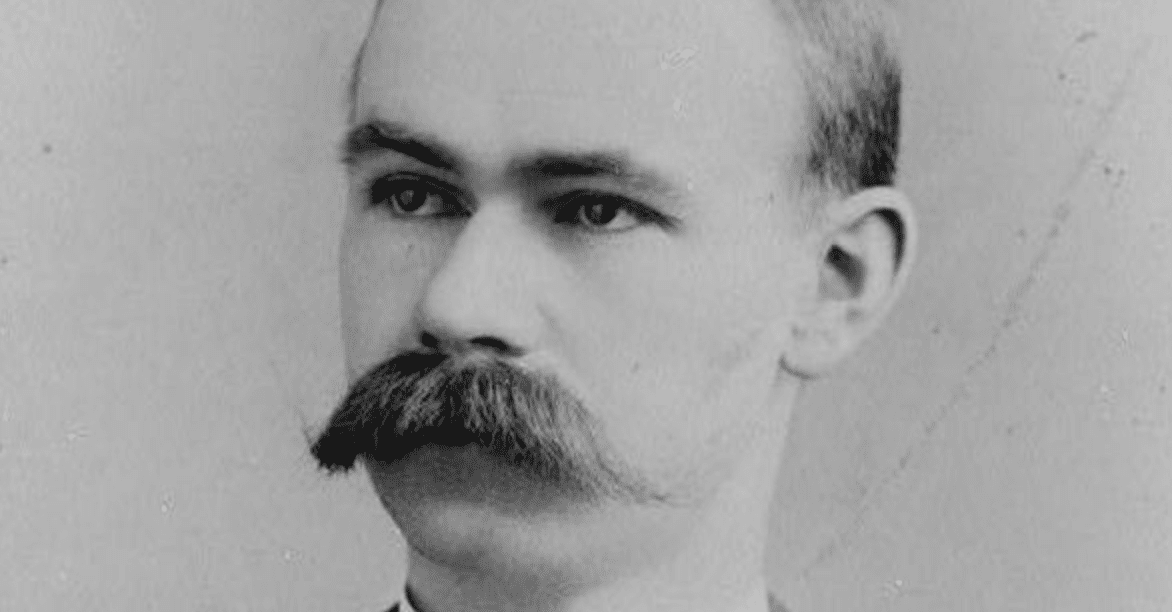

New York is a huge city that has been developing steadily for many decades. Its development and formation were helped by its prominent residents, represented by scientists, politicians, industrialists, entrepreneurs, engineers and other figures. Herman Hollerith, a famous American innovator from Buffalo, New York, also played a part in the development of the city and the way of innovative computing. In particular, he became famous for his work in the field of data processing (DP). His hands and mind designed an innovative electromechanical tabulating machine for punched cards at the time. Hollerith’s device revolutionized the way data was processed and played a crucial role in the development of modern computing. Read more on i-new-york.
Becoming an inventor
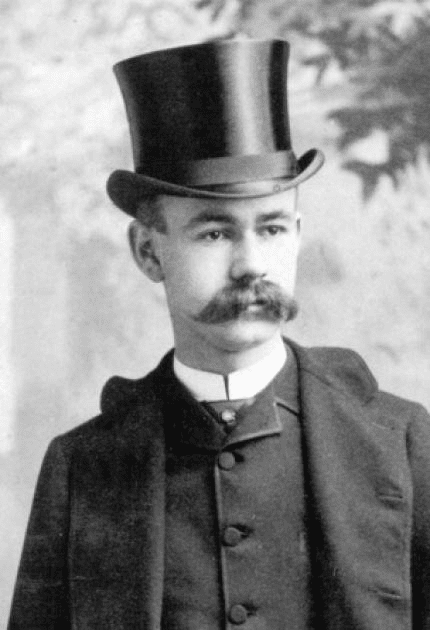
The future inventor was born in Buffalo, near New York City, in 1860. He spent his early days there, exploring the world. He was very fascinated by science and technology, which seemed to be alluring to him. When Hollerith grew up, he moved to NYC, where he continued his education at the City College. His student years were an incredibly intense period of his life. He advanced and took an active part in the academic life of the institution and the city.
Before that, he completed his studies at the Columbia School of Mines with a degree in mining engineering. At the time, he was only 19 years old. Just a year later, he earned his PhD. In particular, he defended his unique scientific work based on developments in the field of tabulation. The young man was so fascinated by engineering that he decided not to stop there, but to share his knowledge with others, while conducting research and scientific development. That’s how he got a job at the Massachusetts Institute of Technology, where he instructed mechanical engineering and performed some of his first experiments with punched cards.
Hollerith’s career and discovery
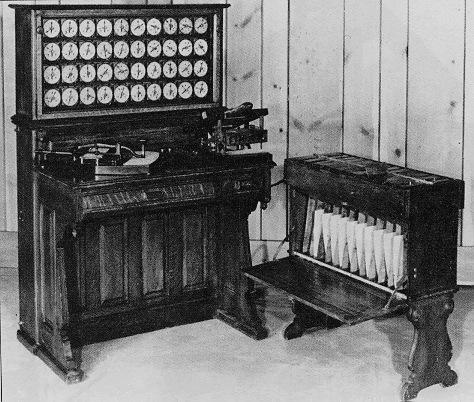
In 1884, Hollerith decided to quit teaching and delve into science. In particular, he took a job at the US Census Bureau, where he encountered a DP problem. He was incredibly inspired by this problem and motivated to develop a more efficient method of DP. Therefore, Hollerith began to actively work on a tabulating machine.
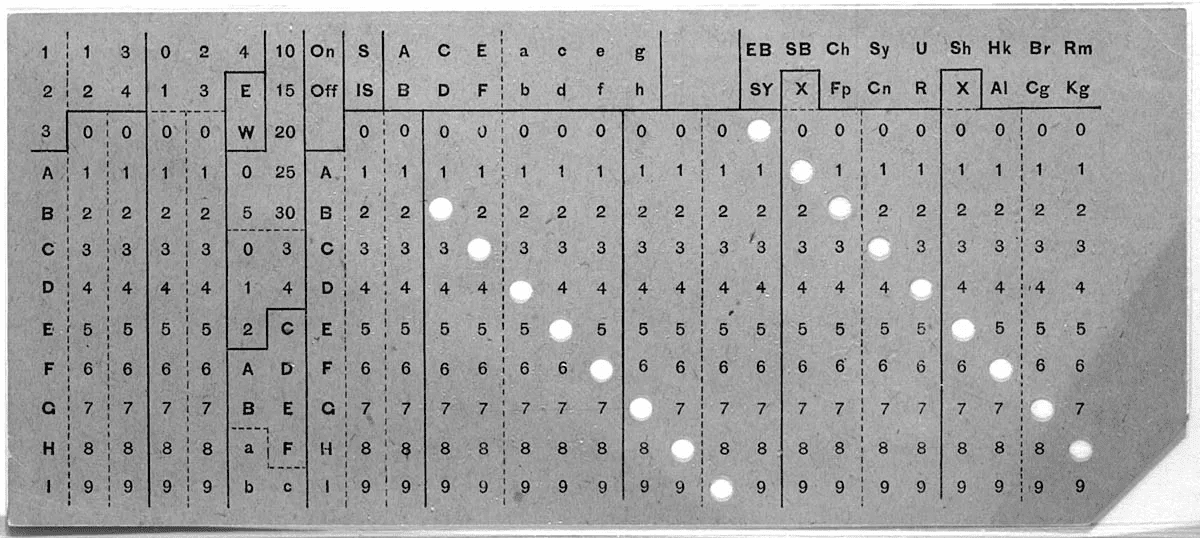
His innovative machine used punched cards to present data, with holes punched in specific locations to encode information such as demographic data from census surveys.
Hollerith’s invention was an electromechanical counting machine. It consisted of a series of electrical contacts and mechanical counters that were connected to a punched card reader. When a card was inserted into the machine, metal brushes detected the presence of holes in the card and triggered the corresponding counters, recording the data encoded on the card.
The use of punch cards and electromechanical components made Hollerith’s counting machine incredibly efficient for the 19th century. Hollerith’s innovative invention significantly lessened the time and labor essential to tabulate census data compared to manual methods. After all, manual calculations were very tedious.
Although Hollerith invented his machine in the early 1880s, it was not until 1890 that it was first put into practice by the US Census Bureau. Its task was to deal with data from the 1890 US census. Hollerith’ machine was an incredible success, performing tabulation in a short period of time and with unprecedented accuracy. Manual calculations would have been incredibly tedious, and there could have been errors because of the human factor.
The significance of the invention and recognition of Hollerith
Hollerith influenced the world of engineering in the late 19th century. After the successful launch of his first invention, in 1896, he determined to set up a company to produce computing machines. He supplied the largest census bureaus and even insurance companies with his machines. Hollerith’s machines were used for censuses in England and Wales, Germany, Italy, Austria, Canada, France, Norway, Puerto Rico, as well as in Russia, Cuba and the Philippines.
Hollerith’s innovative machine laid the foundation for modern DP technology and has had a profound impact on industries beyond the census. These industries include banking, insurance and logistics.
His company, founded in 1896, later merged with others to form the Computing-Tabulating-Recording Company (CTR), which eventually became the world-famous IBM.
Hollerith’s electromechanical counting machine was a very important innovation in the history of computing. In the 19th century, it marked the transition from manual DP to automated systems. His groundbreaking work paved the way for the development of modern computer systems and data analysis methods, which earned him worldwide recognition in the field of information technology.
The heart of the outstanding engineer and scientist stopped beating in 1929, at the age of 69.