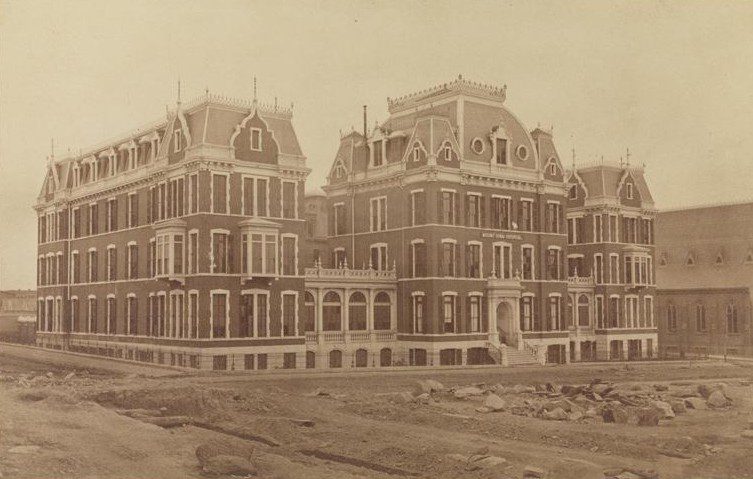

The Mount Sinai Hospital (MSH), a renowned medical institution in NYC, is one of the most esteemed healthcare facilities in the United States. The MSH, established in 1852, has a long and distinguished history of medical innovation and pioneering research. The hospital delivers exceptional medical care to patients from all over the globe, offering a wide range of services, from primary care to advanced specialized treatments. The MSH is also one of the foremost centers of medical education and research, contributing to medical science’s ongoing advancement and new therapies development. For more insights about the hospital‘s history, check out the article on i-new-york.
Background of the hospital’s development
On January 15, 1852, nine representatives of various Jewish charitable groups in NYC agreed to establish free medical care for impoverished Jews. This dream came to life in 1855 when the 45-bed Jews’ Hospital was founded on West 28th Street, between Seventh and Eighth Avenues in NYC.
Despite its Jewish origins, the hospital welcomed patients of all religious backgrounds.
In its early years, as is well known, most patients were immigrants. Since it was a charitable institution, the MSH directors relied on donations from friends and community members along with government payments, to finance the care provided.
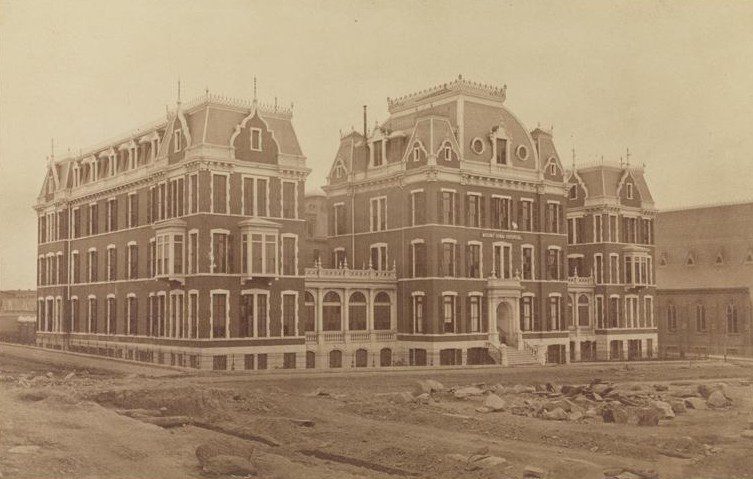
The MSH was enlarged during the Civil War to provide medical care for wounded soldiers. In 1866, the Jews’ Hospital officially dropped its sectarian charter and became known as The Mount Sinai Hospital. By 1872, the MSH relocated to a new facility on Lexington Avenue, situated between 66th and 67th Streets, which had 120 beds and nearly tripled its original capacity.
Expanding The Mount Sinai Hospital’s range of services
The relocation to Lexington Avenue resulted in patient care expanding, with the addition of outpatient services and the introduction of new specialties such as pediatrics, eye and ear care, dermatology, genitourinary and neurology.
What’s interesting is that the first tiny laboratory at The MSHl was just spacious enough for two people and was actually located in a clothes closet. This humble beginning marked the start of a significant focus on research.
In 1881, a nursing training school was established, marking the introduction of professional nursing to the institution. After graduating with 4,700 nurses, The Mount Sinai Hospital School of Nursing officially shut its doors in 1971.
As a result of advances in diagnosis, research and patient care, a growing number of people sought treatment at hospitals. This prompted The MSH executives to recognize the need for further growth and expansion.
The ongoing expansion of the medical center
In 1904, the MSH, featuring 456 beds and 10 pavilions, opened its doors on Fifth Avenue at 100th Street. Hospital President Isaac Wallach referred to it as ‘this House of noble deeds,’ emphasizing its mission focused on ‘benevolence, science and education.’
In just a few short years, the hospital underwent significant growth both in its physical size and the range of services offered, turning into a comprehensive medical center equipped to handle complex health issues.
In 1907, the hospital created a Department of Social Work Services to assist patients in managing both their medical and social needs. This department receives backing from the Auxiliary Board, established in 1916 to offer financial aid and manpower for social service initiatives at the hospital. The Auxiliary is dedicated to promoting essential projects that benefit both the hospital and the surrounding communities.
The MSH and its role in the Wars
The MSH played a significant role during both World Wars by dispatching medical teams. Among the 24 doctors and 65 nurses who worked with Base Hospital No. 3 of the U.S. Army Medical Corps in France during World War I, most of the medical staff hailed from The MSHl. This dedicated team transformed a 15th-century monastery in Vauclaire, Dordogne, into a 500-bed hospital that once served up to 2,800 patients at its peak.
During World War II, almost 900 doctors, nurses, staff and trustees from The MSH served in the military. The connected unit, the U.S. Army 3rd General Hospital, was active in North Africa, Italy and France. Tragically, nine people linked to Mount Sinai lost their lives while serving.
Establishing a School of Medicine
In the late 1950s, the hospital began considering the idea of establishing its own School of Medicine, which was pretty rare for a healthcare institution at the time. When it opened in 1963, Mount Sinai School of Medicine—now known as the Icahn School of Medicine at Mount Sinai—became the first medical school to emerge from a non-university institution in over half a century. The hospital’s decision to establish the school really underscores its long-standing commitment to outstanding patient care and research.
Mount Sinai School of Medicine was established in 1968 in partnership with The City University of New York. The founders aimed to create a unique medical institution—a university focused on health sciences. This innovative establishment would include a medical school backed by a robust teaching hospital, a graduate school for physical and biological sciences and undergraduate programs for allied health professionals.
The first graduating class of students at the new Mount Sinai School of Medicine numbered 36, including four women. That same year, there were 23 students in the third-year class and 19 in the Graduate School of Biological Sciences. In 2007, the school started admitting 140 students per incoming class and today, there are over 300 graduate students enrolled at any time.
A medical institution in the 21st century
At the beginning of the 21st century, The MSH encountered financial challenges. However, by the end of the hospital’s 150th anniversary celebration in 2002, initiatives were already in progress to establish a new direction.
Kenneth L. Davis, MD, who graduated from the Mount Sinai School of Medicine in 1973, was appointed as the Dean of the School of Medicine. Then, on March 24th, he took on the additional role of President and CEO of the Mount Sinai Health System. After four years, the two positions were separated and Dennis S. Charney, MD, became the new Dean of the School of Medicine.
Throughout the 2020s, MSH continues to advance and lead the way by remaining committed to exceptional patient care and education, blending both theory and practice.
Some intriguing facts about the MSH
The Mount Sinai Hospital in NYC boasts several intriguing facts.
- The MSH was among the earliest hospitals in the United States to adopt a system for recording and keeping track of patient medical records. It occurred back in the late 19th century and marked the beginning of what we now recognize as a modern medical record system.
- Advancements in the field of science. The MSH is a hub for groundbreaking research and scientific advancement. Its advancements in genetics, oncology, cardiology and other medical fields are well recognized. The institution has pioneered several sophisticated diagnostic and treatment techniques.
- Many famous individuals, both patients and doctors, have received treatment and conducted research at the MSH. This includes well-known figures such as Mark Twain and Albert Einstein, among others.
- Development of an institution. The MSH is home to the Icahn School of Medicine at the City University of New York, fostering medical education and research in the area.
These facts emphasize once again the significance and exceptional quality of the MSH as a top-tier medical institution.